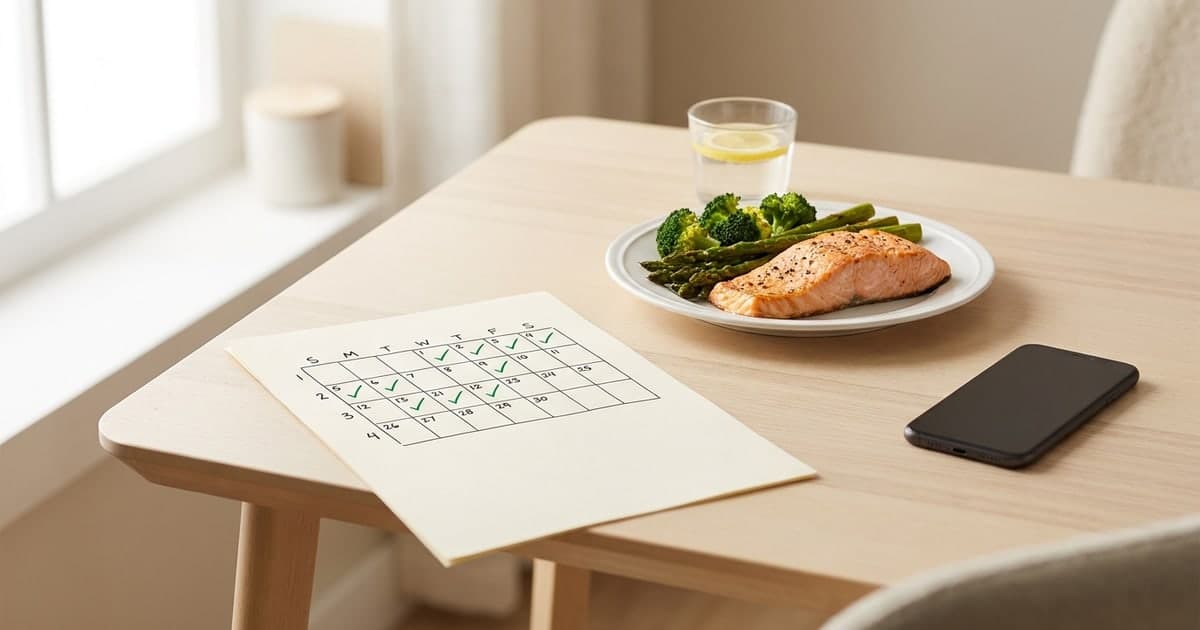
75 Hard vs 75 Soft: Which One Should You Actually Do?
Choosing between 75 Hard and 75 Soft looks like choosing a difficulty setting. It isn't. The two programs disagree about something much more fundamental: what a bad day means.
75 Hard says a bad day is evidence you were never serious — and deletes your progress to prove it. 75 Soft says a bad day is Tuesday — and asks you to show up Wednesday. Everything else, the water and the workouts and the reading, is detail hanging off that one philosophical fork.
Here's the rule-by-rule comparison, the honest cases for each, and the question that actually decides it.
The rules, side by side
| 75 Hard | 75 Soft | |
|---|---|---|
| Duration | 75 days | 75 days |
| Diet | Any strict diet, zero cheat meals, zero alcohol | "Eat well," alcohol on social occasions only |
| Exercise | Two 45-min workouts daily; one outdoors, any weather | One 45-min workout daily; one recovery day per week |
| Water | 1 gallon (3.8 L) | 3 liters |
| Reading | 10 pages, nonfiction only | 10 pages, any book |
| Progress photo | Daily, mandatory | Not required |
| Miss a task | Restart from Day 1 | Continue tomorrow |
| Origin | Andy Frisella, 2019, "mental toughness program" | Community remix, ~2022, popularized on TikTok |
Weekly training volume is the number worth staring at: roughly 630 minutes on Hard versus roughly 270 minutes on Soft. Public-health guidelines recommend 150–300 minutes of moderate activity per week. One of these programs sits inside the evidence; the other laps it twice and calls the guidelines soft.
The case for 75 Hard
There's a reason the original still dominates, and it's not marketing alone.
Binary rules kill negotiation. "Eat well" can be argued with at 9 PM in front of an open fridge. "Zero cheat meals" cannot. For people whose diets die by a thousand small exceptions, bright lines genuinely work better than moderation — this is one of the most consistent findings in habit psychology.
The stakes manufacture meaning. Knowing that Day 43 exists only because you defended all 42 days before it creates an identity effect that gentle programs rarely produce. People don't tattoo "75 Soft finisher" on their forearms.
It filters for the right user. If your training base is solid, your calendar is stable, and your relationship with food is boring, 75 Hard is less dangerous than its critics suggest — a hard-but-doable project with a clear finish line.
The cost: no rest days for 11 weeks, a water target beyond physiological reference values, and a restart mechanic that turns a stomach bug on Day 60 into 60 lost days. We covered the full criticism in the 75 Hard deep dive.
The case for 75 Soft
You can actually finish it. The exercise volume is survivable for a beginner, the rest day is where adaptation happens, and one slip costs one day instead of all of them. A challenge's results only exist if you reach the end; finishability isn't a compromise, it's the whole product.
It builds habits that outlive Day 75. Forty-five daily minutes is a volume you might keep doing in week 20. Nobody keeps doing two-a-days. The program you can sustain past the finish line is the one that changes your year, not just your quarter.
It respects real life. Weddings, deadlines, sick kids — 75 Soft absorbs them. That's not softness; that's design that acknowledges you have a life the challenge must fit inside.
The cost: almost nothing in 75 Soft is verifiable. "Eat well" is judged by the same person it's supposed to constrain, there are no checkpoints, and the program fails silently — you can be "on it" for weeks after it stopped meaning anything. The 75 Soft guide covers how to patch that with your own measurement.
The question that actually decides it
Not "how tough am I?" — that question sells books. The real one:
When you miss a day — and over 75 days, you will — does deleting your progress make you more likely to come back, or less?
A small group of people genuinely responds to the guillotine: the threat keeps them perfect, and perfection keeps them in. If that's you, and your body and calendar can carry 630 weekly minutes, pick Hard.
Most people respond the other way. The restart doesn't refocus them — it releases them. Day 1 after a Day-40 failure feels so expensive that "next Monday" becomes "next January." If a missed day has ever ended your entire attempt at anything, pick Soft — and give it teeth with a written definition of "eat well," a real calorie target, and meal logging that exists outside your memory. (Photo-logging takes about 3 seconds a meal — you can try it in your browser.)
And if weight loss is the actual goal behind the challenge, remember that neither program measures energy balance — the thing that determines whether weight loss happens at all. A challenge is a delivery mechanism for consistency, not a substitute for a target.
The third option both camps ignore
The Hard-vs-Soft debate assumes your only choices are punishment or vibes. Full disclosure — we built the third option into our app, so judge accordingly: it's called Reset 21.
The design steals from both sides. From Hard: rules are binary and non-negotiable — scan two meals, hit your water, hit your steps, keep meals above a quality grade, stay inside your calorie budget, log your exercise. From Soft: the schedule is humane (21 days, phased difficulty, rest built into the thresholds). And it adds the thing neither has: rules verify themselves from what you log — the app checks your meal scans, water log, and steps, so there's no honor system to erode by Day 40.
Its bad-day mechanic sits deliberately between the two philosophies: a silent day freezes the run, and finishing the next day buys it back. Two silent days in a row end it. One bad Tuesday can't erase three good weeks — but you also can't ghost the program for a week and call it a challenge. The complete Reset 21 breakdown explains the phases and the science; the wider field of options is in our 75 Hard alternatives ranking.
FAQ
Is 75 Soft as effective as 75 Hard?
For building durable habits, it's arguably more effective, because dramatically more people reach Day 75 and keep the routine afterward. For raw short-term output — training volume, alcohol elimination, forced discipline — 75 Hard demands more and, when completed, delivers more. "Effective" depends on whether the metric is the transformation photo or the year that follows it.
Can I switch from 75 Hard to 75 Soft mid-challenge?
You can do anything you want — but by 75 Hard's own rules, the moment you modify it, you're no longer doing 75 Hard. A cleaner mental model: end the Hard attempt, start a Soft run with a Day 1 you're honest about. The calendar doesn't care, and neither should you.
Which is better for weight loss, 75 Hard or 75 Soft?
Whichever one you pair with an actual calorie target and finish. Hard's higher training volume burns more, but its restart mechanic ends most attempts early; Soft is finishable but never checks your intake. Weight change over 75 days comes down to average energy balance — set the number, track against it, and either challenge becomes a vehicle for it.
Is there a 21-day version of 75 Hard?
That's roughly the slot our Reset 21 occupies: a shorter window, six binary rules that check themselves off from your food, water, and step logs, weigh-in checkpoints, and a freeze-and-buy-back mechanic instead of restart-from-zero. Shorter doesn't mean easier — it means the finish line is close enough to stay real.
Ready to track smarter?
Snap a photo, get your calories, macros, and Health Score instantly. See what other trackers miss.
Download Calsy — It's Free